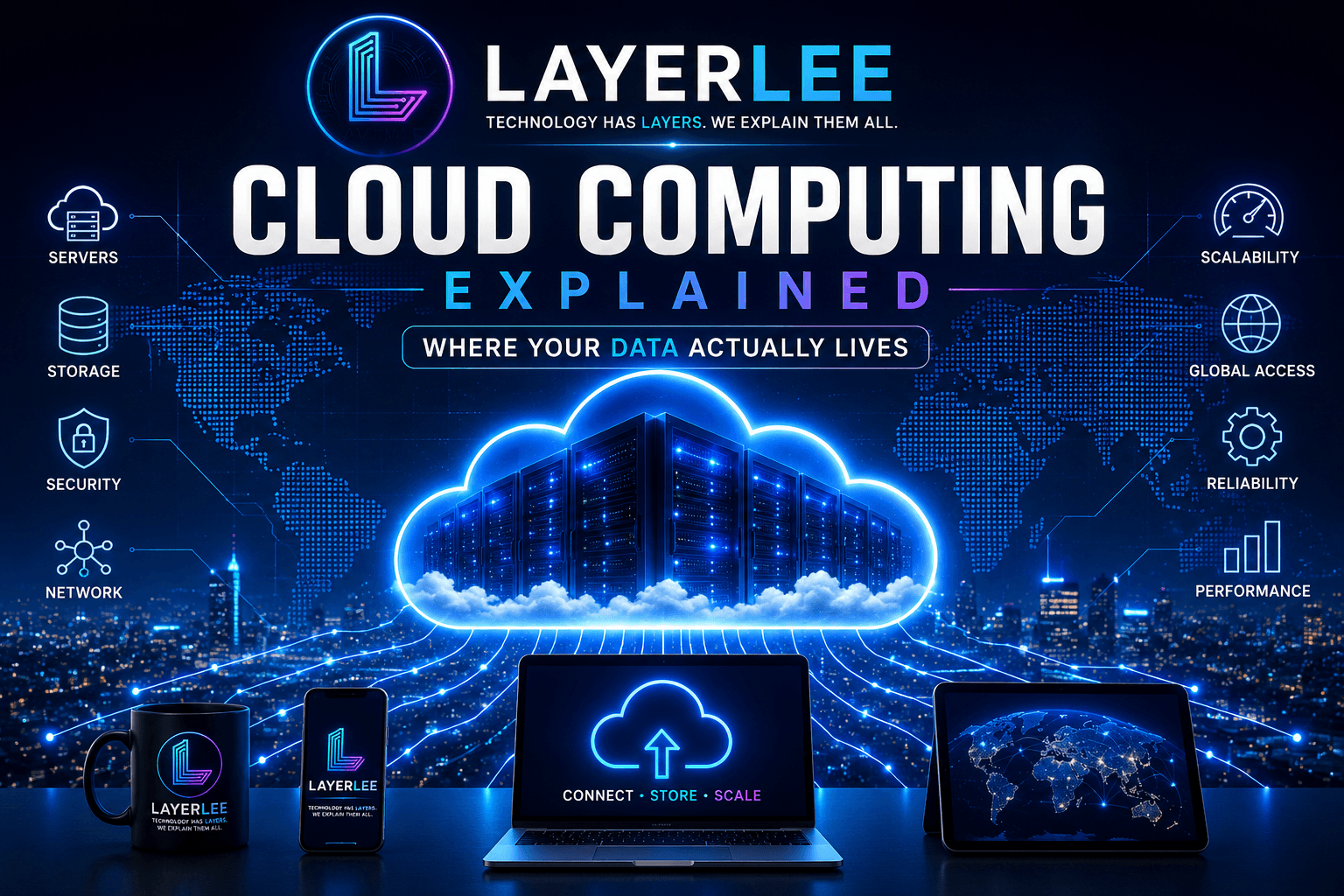
Cloud Computing Explained: Where Your Data Actually Lives
You have probably heard this sentence hundreds of times:
"Your files are stored in the cloud."
Your photos are in the cloud.
Your emails are in the cloud.
Netflix runs in the cloud.
Businesses run in the cloud.
Even artificial intelligence increasingly runs in the cloud.
But there is one problem with that word.
The cloud isn't actually in the sky.
So where is it?
If you upload a photo from your phone, where does that photo physically go?
Who stores it?
Which computer receives it?
And how can you access it again from almost anywhere in the world?
To understand the cloud, we need to remove the mystery.
The cloud is not magic.
It is a gigantic global system of computers, storage devices, networks, software, and data centers working together.
The Hidden Truth: The Cloud Is Someone Else's Computer
The simplest explanation of cloud computing is surprisingly ordinary.
Instead of owning and maintaining all the computers needed to run an application, you use computing resources owned and operated by another company.
Imagine you want to build a website.
You need somewhere to store:
- Your website files
- Your database
- User accounts
- Images
- Videos
- Application code
You could buy your own physical server.
You would need to:
- Purchase the hardware
- Install it
- Maintain it
- Replace broken parts
- Keep it cool
- Protect it from attacks
- Maintain electricity
- Upgrade it when demand grows
That quickly becomes expensive and difficult.
Cloud computing changes the model.
Instead of buying the entire machine, you can rent computing resources when you need them.
That is the basic idea.
The cloud allows computing resources to be delivered over a network instead of requiring you to own and manage all the physical hardware yourself.
But that still leaves an important question.
Where is the actual hardware?
Welcome to the Data Center
Somewhere in the real world, there are enormous buildings filled with computers.
These buildings are called data centers.
Inside them are rows and rows of servers.
A server is simply a computer designed to provide services to other computers.
Depending on the system, servers may handle:
- Websites
- Applications
- Databases
- File storage
- Video streaming
- Artificial intelligence
- Backups
- Authentication
But data centers need much more than computers.
They also need:
- Massive network connections
- Backup power
- Cooling systems
- Security
- Fire protection
- Monitoring
- Redundant equipment
Why?
Because if millions of people depend on an online service, one ordinary computer is not enough.
Imagine an app with 10 million users.
If everything depended on one machine and that machine failed, the entire service could disappear.
So cloud infrastructure is designed around scale and redundancy.
# What Happens When You Upload a File?
Let's make this real.
Imagine you take a photograph and upload it to a cloud storage service.
The journey might look something like this:
Your Phone
    ↓
Internet Connection
    ↓
Internet Service Provider
    ↓
Network Infrastructure
    ↓
Cloud Service
    ↓
Data Center
    ↓
Storage System
    ↓
Copies / Replication
Written by Bipin Baral
Full-stack software engineer writing empirical, people-first technical breakdowns on operating systems, distributed systems, and backend architecture.
Frequently Asked Questions
Deep-dive answers and explanations about Cloud Computing Explained: Where Your Data Actually Lives