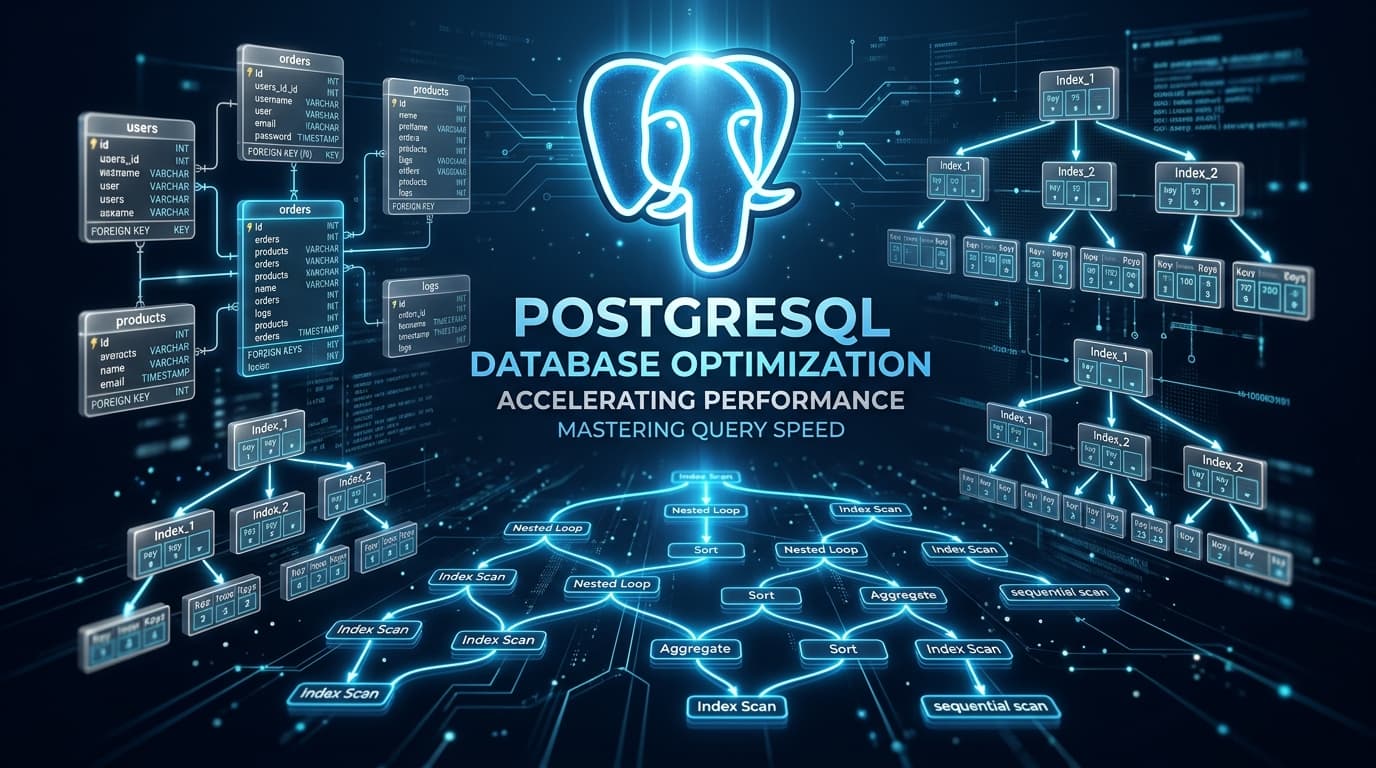
Why Your PostgreSQL Queries Are Slow
Nine times out of ten, a slow PostgreSQL query falls into one of four categories:
- Missing index — PostgreSQL is doing a full sequential scan (Seq Scan) on millions of rows
- Wrong index type — B-tree index on a JSONB column that needs GIN
- N+1 queries — Your ORM is executing 1 + N queries when 1 JOIN would do
- Poor query structure — Using functions on indexed columns, preventing index use
Let's fix all of them.
Understanding PostgreSQL Index Types
B-Tree (Default) — For Equality and Range Queries
-- Perfect for: = , <, >, BETWEEN, LIKE 'prefix%'
CREATE INDEX idx_users_email ON users (email);
CREATE INDEX idx_posts_published_at ON posts (published_at DESC);

-- Composite index — order matters!
-- This index supports: WHERE status = ? AND published_at = ?
-- But NOT: WHERE published_at = ? alone
CREATE INDEX idx_posts_status_date ON posts (status, published_at DESC);
GIN (Generalized Inverted Index) — For Full-Text Search & JSONB
-- Full-text search
ALTER TABLE posts ADD COLUMN search_vector tsvector
  GENERATED ALWAYS AS (
    to_tsvector('english', title || ' ' || content)
  ) STORED;

CREATE INDEX idx_posts_search ON posts USING GIN (search_vector);

-- Fast full-text query
SELECT * FROM posts
WHERE search_vector @@ plainto_tsquery('english', 'kubernetes docker');

-- JSONB containment queries
CREATE INDEX idx_users_metadata ON users USING GIN (metadata);

-- Find users where metadata contains specific key-value
SELECT * FROM users WHERE metadata @> '{"role": "admin"}';
BRIN (Block Range Index) — For Naturally Ordered Large Tables
-- Ideal for time-series data where rows are inserted in order
-- Tiny index size: 1 entry per 128 pages (vs B-tree: 1 entry per row)
CREATE INDEX idx_events_created_at ON events USING BRIN (created_at);

-- 1 billion row table: B-tree = 21GB, BRIN = 400KB
Partial Indexes — Index Only What You Query
-- 95% of posts are published. Queries almost always filter by status='published'
-- Only index published posts — fraction of the rows
CREATE INDEX idx_published_posts ON posts (published_at DESC)
WHERE status = 'published';

-- This index is 95% smaller than a full index and fits in RAM
Reading EXPLAIN ANALYZE
EXPLAIN ANALYZE is your X-ray machine:
EXPLAIN (ANALYZE, BUFFERS, FORMAT TEXT)
SELECT u.name, COUNT(p.id) as post_count
FROM users u
LEFT JOIN posts p ON p.user_id = u.id
WHERE u.created_at > '2026-01-01'
GROUP BY u.id, u.name
ORDER BY post_count DESC
LIMIT 10;
Sample output:
Limit (cost=1234.56..1234.57 rows=10 width=48) (actual time=45.123..45.131 rows=10 loops=1)
  -> Sort (cost=1234.56..1284.56 rows=20000 width=48) (actual time=45.120..45.124 rows=10 loops=1)
       Sort Key: (count(p.id)) DESC
       Sort Method: top-N heapsort  Memory: 25kB
       -> HashAggregate (cost=789.00..989.00 rows=20000 width=48) (actual time=38.234..43.891 rows=18432 loops=1)
            Group Key: u.id
            -> Hash Left Join (cost=234.00..689.00 rows=40000 width=16) (actual time=5.432..28.901 rows=45231 loops=1)
                 Hash Cond: (p.user_id = u.id)
                 -> Seq Scan on posts p ...   ← ⚠️ FULL TABLE SCAN!
                 -> Hash (cost=184.00..184.00 rows=4000 width=12) (actual time=4.321..4.321 rows=4000 loops=1)
                      -> Index Scan using idx_users_created_at on users u ...
Buffers: shared hit=1234 read=5678   ← read=5678 means disk I/O — needs more caching
Planning Time: 1.234 ms
Execution Time: 45.678 ms            ← Our target: <10ms
Red flags to look for:
Seq Scanon large tables = missing indexBuffers: shared read(high number) = data not in memorySort Method: external merge Disk= sort doesn't fit in work_memRows Removed by Filter(large number) = filtering is happening after scan
Fix the Seq Scan on posts:
CREATE INDEX idx_posts_user_id ON posts (user_id);Table Partitioning — For Massive Tables
When a table exceeds 100M rows, partitioning dramatically improves query performance by limiting scans to relevant partitions.
Range Partitioning by Date
-- Parent table
CREATE TABLE events (
  id          BIGSERIAL,
  user_id     UUID NOT NULL,
  event_type  VARCHAR(50) NOT NULL,
  payload     JSONB,
  created_at  TIMESTAMPTZ NOT NULL DEFAULT NOW()
) PARTITION BY RANGE (created_at);

-- Monthly partitions
CREATE TABLE events_2026_01 PARTITION OF events
  FOR VALUES FROM ('2026-01-01') TO ('2026-02-01');
CREATE TABLE events_2026_02 PARTITION OF events
  FOR VALUES FROM ('2026-02-01') TO ('2026-03-01');
-- ... continue for each month

-- Index each partition (PostgreSQL 11+ allows global indexes too)
CREATE INDEX ON events_2026_01 (user_id, created_at);
CREATE INDEX ON events_2026_02 (user_id, created_at);
Querying with a date filter now only scans the relevant partition:
-- Only scans events_2026_08 partition
SELECT * FROM events
WHERE created_at BETWEEN '2026-08-01' AND '2026-08-31'
AND user_id = 'abc-123';
Connection Pooling with PgBouncer
PostgreSQL can handle ~100-300 concurrent connections efficiently. Above that, performance degrades due to memory overhead and context switching. PgBouncer is a lightweight connection pooler that sits between your app and PostgreSQL.
# pgbouncer.ini
[databases]
myapp = host=postgres port=5432 dbname=myapp

[pgbouncer]
pool_mode = transaction          # One DB connection per transaction
max_client_conn = 1000           # Handle 1000 app connections
default_pool_size = 20           # With only 20 real DB connections
reserve_pool_size = 5
reserve_pool_timeout = 3
server_idle_timeout = 600
Transaction mode = one PostgreSQL connection per transaction unit, releasing immediately after. Your app can have 1000 connections while PostgreSQL only sees 25.
Common Query Anti-Patterns
Anti-Pattern 1: Function on Indexed Column
-- ❌ BAD — prevents index use on email
SELECT * FROM users WHERE LOWER(email) = 'bipin@example.com';

-- ✅ GOOD — use expression index
CREATE INDEX idx_users_email_lower ON users (LOWER(email));
SELECT * FROM users WHERE LOWER(email) = 'bipin@example.com';

-- ✅ EVEN BETTER — enforce lowercase at insert time
ALTER TABLE users ADD CONSTRAINT email_lowercase
  CHECK (email = LOWER(email));
Anti-Pattern 2: OFFSET for Pagination
-- ❌ BAD — OFFSET 100000 still reads 100000 rows
SELECT * FROM posts ORDER BY created_at DESC LIMIT 10 OFFSET 100000;

-- ✅ GOOD — Keyset/cursor pagination
SELECT * FROM posts
WHERE created_at < '2026-08-01T12:00:00Z'  -- cursor from last page
ORDER BY created_at DESC
LIMIT 10;
Anti-Pattern 3: SELECT *
-- ❌ BAD — fetches all columns including large TEXT/JSONB fields
SELECT * FROM posts WHERE id = $1;

-- ✅ GOOD — only fetch what you need
SELECT id, title, excerpt, published_at, author FROM posts WHERE id = $1;
Conclusion
PostgreSQL performance optimization is a skill that pays compounding dividends. Understanding index types, reading EXPLAIN ANALYZE, strategic use of partial indexes, table partitioning for large datasets, and connection pooling will take your database from a bottleneck to a competitive advantage. The best time to think about these patterns is at schema design time — but it's never too late to EXPLAIN ANALYZE your slowest queries.

Written by Bipin Baral
Full-stack software engineer writing empirical, people-first technical breakdowns on operating systems, distributed systems, and backend architecture.
Frequently Asked Questions
Deep-dive answers and explanations about PostgreSQL Performance Mastery: Indexes, EXPLAIN ANALYZE, Partitioning & Query Optimization